The Way We Learn Is Being Rewritten
Not long ago, learning a new skill meant enrolling in a class, buying a textbook, or finding someone willing to teach you. It meant fixed schedules, generic curricula, and the quiet frustration of moving at someone else’s pace. That world is disappearing fast.
Artificial intelligence is not just improving education — it is fundamentally redesigning it. From personalized learning paths to real-time feedback, AI is making skill acquisition faster, smarter, and more accessible than at any point in human history. Whether you want to learn Python, pick up a new language, or master graphic design, AI-powered tools are now your most powerful ally. This shift is not coming. It is already here.
Why Traditional Learning Models Are Breaking Down
The traditional classroom was built for a different era. It assumed that all students learn at the same pace, respond to the same teaching style, and need the same content delivered in the same order. For decades, educators and learners alike knew this was flawed — but there was no scalable alternative.
AI changes that equation entirely. Machine learning algorithms can now analyze how an individual learner processes information, identify gaps in real time, and adjust the difficulty, format, and sequence of content accordingly. This is not a minor upgrade. It is a structural shift in how knowledge is transferred from one mind to another.
The result is a learning experience that feels less like attending a lecture and more like working with a personal tutor who never gets tired, never loses patience, and always knows exactly where you are struggling.
Personalized Learning Paths: The Core of AI-Driven Education
Personalization is the headline feature of AI in education. Unlike a static online course that delivers the same video to every student, AI systems continuously adapt based on your performance data. They track which concepts you grasp quickly, which ones you revisit, how long you spend on each module, and where your attention drops. Then they recalibrate.
This adaptive learning model has been shown to dramatically improve retention and completion rates. According to research published by McKinsey & Company, personalized learning approaches can improve student outcomes by 20 to 30 percent compared to one-size-fits-all methods. mckinsey.com
The practical impact is significant. A learner studying data science, for example, no longer has to sit through three hours of foundational statistics if they already have a quantitative background. The AI identifies prior knowledge and skips ahead — saving time and keeping motivation high.
AI Tutors and Conversational Learning
One of the most visible signs of AI’s impact on skill development is the rise of AI-powered tutoring systems. These tools use natural language processing to simulate real tutoring conversations, answering questions, explaining concepts in multiple ways, and prompting learners to think critically rather than just consume content.
Khan Academy — Khanmigo
Khan Academy’s AI tutor, Khanmigo, is one of the clearest examples of this technology at scale. Rather than simply providing answers, Khanmigo guides learners through problem-solving using the Socratic method — asking probing questions that lead the student to discover the answer themselves. This approach builds genuine understanding rather than surface-level memorization. Khan Academy reports that learners using Khanmigo spend significantly more time on task and demonstrate stronger conceptual retention.
Duolingo — Duolingo Max
Language learning platform Duolingo has integrated GPT-4 into its premium tier, Duolingo Max, introducing features like “Explain My Answer” and “Roleplay.” These features allow learners to have open-ended conversations with AI characters, practice real-world dialogue scenarios, and receive instant explanations of grammar rules in context. The result is a language learning experience that feels far more dynamic and immersive than flashcard-style repetition.
Real-Time Feedback: Closing the Learning Loop Faster
Feedback is one of the most critical components of skill acquisition. The faster and more specific the feedback, the faster learning accelerates. Traditional education systems are notoriously slow at this — assignments sit ungraded for days, and by the time feedback arrives, the learner has often moved on mentally.
AI collapses this delay entirely. Platforms now deliver instant, granular feedback on everything from essay structure to code quality to pronunciation accuracy. A student writing an essay receives suggestions on argument clarity, sentence-level grammar, and citation formatting in real time. A software developer gets automated code reviews that explain not just what is wrong, but why — and how to fix it.
This immediacy transforms the feedback loop from a passive, delayed event into an active, continuous part of the learning process.
The Skills Most Impacted by AI Learning Tools
Not every skill benefits equally from AI-assisted learning, but the range is broader than most people expect. Below is a clear breakdown of how AI tools are being applied across different skill domains.
| Skill Domain | AI Application | Key Tools/Platforms |
|---|---|---|
| Programming & Coding | Code completion, automated review, debugging assistance | GitHub Copilot, Replit AI, CodeSignal |
| Language Learning | Conversational AI, pronunciation feedback, adaptive vocabulary | Duolingo Max, Babbel AI, Pimsleur |
| Creative Writing | Style analysis, structural feedback, idea generation | Jasper, Sudowrite, ChatGPT |
| Data Science & Analytics | Guided project walkthroughs, concept checks, adaptive quizzes | DataCamp, Coursera AI, Kaggle |
| Music & Audio | Chord recognition, composition feedback, ear training | Yousician, ScoreCloud |
| Soft Skills & Communication | Role-play simulations, tone analysis, confidence scoring | Speeko, Poised, Rehearsal AI |
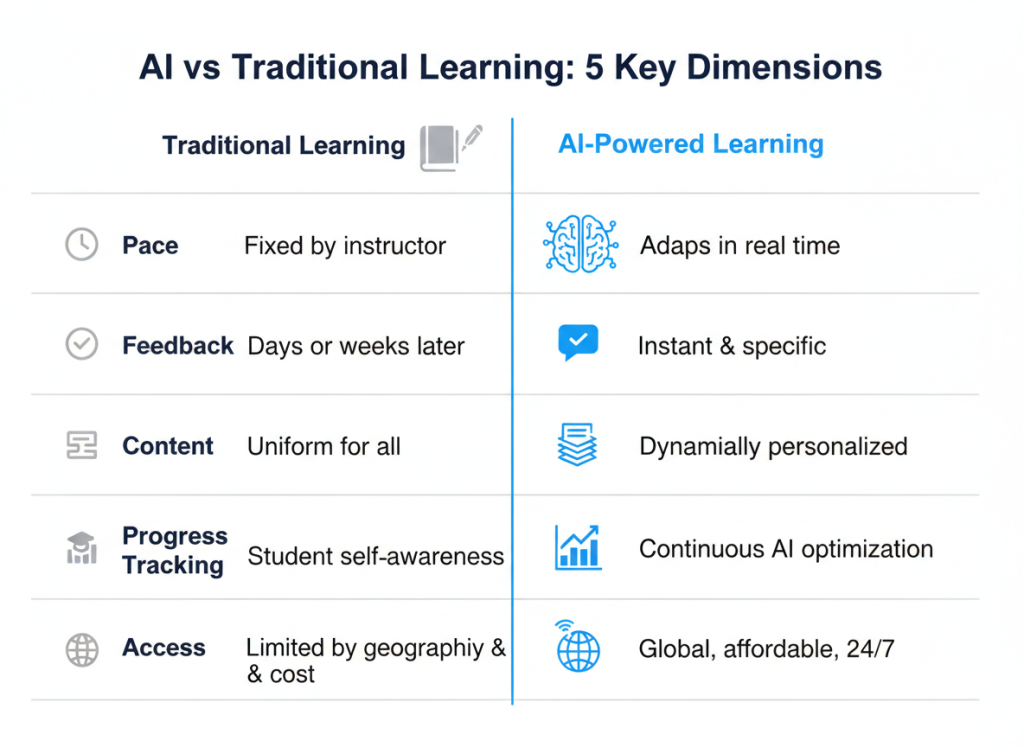
Infographic: The AI Learning Advantage
(See the generated infographic below for a visual summary of this section.)
The shift from traditional to AI-enhanced learning can be summarized across five key dimensions. In a traditional learning environment, the pace is fixed by the instructor, feedback arrives days or weeks after submission, content is uniform for all learners, progress depends heavily on student self-awareness, and access is limited by geography and cost. In an AI-powered environment, pace adapts to the individual learner in real time, feedback is instant and specific, content is dynamically personalized, progress is continuously tracked and optimized by algorithms, and access is available globally at a fraction of traditional costs.
Microlearning and AI: Making Time Work for Modern Learners
Modern learners are time-poor. Full-time professionals trying to reskill cannot dedicate three hours a night to online courses. AI has responded to this reality by powering a microlearning revolution — breaking complex skills into small, focused learning units that can be completed in five to fifteen minutes.
AI systems determine which micro-modules are most relevant for a given learner at a given moment, scheduling them at optimal times based on spaced repetition science. Spaced repetition is a memory technique that schedules review sessions at increasing intervals — reinforcing information just before it would typically be forgotten. AI makes this process automatic and invisible. The learner simply shows up; the algorithm does the rest.
Platforms like Blinkist, Coursera, and LinkedIn Learning have all built AI-driven microlearning features that integrate with professional development goals, recommending content based on career trajectory, skill gaps identified from job market data, and individual learning history.
The Role of AI in Corporate Skill Development
The impact of AI on skill learning is not limited to individual learners. Corporations are rapidly adopting AI-powered learning management systems (LMS) to train workforces at scale.
Workday Learning
Workday has embedded AI into its LMS to build personalized employee learning journeys. The system analyzes an employee’s current role, performance data, and career goals, then curates a learning path that connects directly to business outcomes — reducing time-to-competency for new hires and identifying upskilling opportunities for existing staff.
Cornerstone OnDemand
Cornerstone OnDemand uses AI to match employees with learning content not just based on their job title but based on their demonstrated skill gaps and peer benchmarking. This moves corporate training from a compliance checkbox to a genuine development engine.
The business case for this shift is compelling. According to the World Economic Forum, 44 percent of workers’ core skills will be disrupted by 2027, meaning employers face an enormous reskilling challenge. weforum.org AI-powered learning systems are the only scalable solution to that challenge.
Democratizing Access to Expert-Level Instruction
Perhaps the most profound impact of AI on learning is the one that receives the least attention: democratization. Before AI, access to high-quality instruction was unevenly distributed. Elite universities, expensive tutors, and well-resourced school districts produced better-educated graduates. Geography, income, and social capital determined educational opportunity as much as individual effort.
AI disrupts this hierarchy. A student in rural Nigeria and a student in New York City can now access the same AI tutor, the same adaptive curriculum, and the same real-time feedback. The quality of instruction is no longer gated by postal code or parental income.
Organizations like Khan Academy and Coursera have made this their explicit mission, and AI dramatically amplifies their ability to deliver on it. Coursera’s AI-powered features, including personalized course recommendations and AI-graded assignments, are now available to learners in over 190 countries. coursera.org
Challenges and Honest Limitations
It would be intellectually dishonest to present AI in learning as an unqualified success. Several real challenges deserve acknowledgment.
Engagement and motivation remain complex problems. AI can personalize content, but it cannot manufacture intrinsic motivation. Learners who struggle with discipline and self-direction in traditional settings often struggle in AI-powered environments too — especially in asynchronous, self-paced formats. The dropout rate for online courses, even AI-enhanced ones, remains high.
Depth versus breadth is another tension. AI systems are highly effective at building procedural competence — the ability to perform a task. They are less effective at fostering the deep, integrative thinking that comes from sustained engagement with complex ideas, mentorship from human experts, and collaborative learning with peers. These dimensions of learning still require human connection.
Data privacy is a legitimate concern. AI learning systems collect vast amounts of behavioral data to function well. How that data is stored, who has access to it, and how it might be used commercially are questions that learners, institutions, and regulators are still working through.
Finally, algorithmic bias poses a risk. If the data used to train AI learning systems reflects historical inequalities, the recommendations and assessments these systems produce may replicate or amplify those inequalities — undermining the democratization promise.
What the Future of AI-Powered Learning Looks Like
The current generation of AI learning tools is impressive. The next generation will be transformative. Several emerging developments point toward where this is heading.
| Emerging Technology | Expected Impact on Learning | Timeline Estimate |
|---|---|---|
| Multimodal AI tutors | Voice, vision, and text-based tutoring in one interface | 2025–2027 |
| Emotion-sensing AI | Systems that detect frustration or disengagement and adapt | 2026–2028 |
| AI-generated simulations | Immersive, scenario-based skill practice environments | 2025–2027 |
| Verified AI credentials | Blockchain-backed skill verification from AI assessments | 2027–2030 |
| Ambient learning systems | AI integrated into workflows for learning-in-the-flow-of-work | 2026–2029 |
Multimodal AI tutors will soon be able to watch a learner attempt a physical task via video, provide verbal coaching in real time, and follow up with written summaries — creating a closed-loop learning experience that mirrors elite human coaching. Emotion-sensing systems will detect when a learner is frustrated, bored, or overwhelmed, and adjust content or pacing accordingly. AI-generated simulations will allow professionals to practice high-stakes scenarios — a surgeon rehearsing a procedure, a sales executive handling a difficult negotiation — without real-world risk.
The Human Element Will Never Disappear
AI is a powerful accelerant, but it is not a replacement for the full human experience of learning. The best outcomes will consistently come from environments that blend AI’s analytical precision with human mentorship, peer collaboration, creative exploration, and emotional support.
The learners who will thrive in this new landscape are those who treat AI as a tool rather than a crutch — using it to accelerate skill acquisition, surface blind spots, and maintain momentum, while continuing to seek out human connection, real-world application, and the kind of deep reflection that no algorithm can generate.
Skill development has always been one of the most fundamentally human activities. AI does not change that truth. It simply gives us better tools to pursue it.